
Beenham Primary School Valuing ourselves. Valuing everybody.
Curriculum
Beenham Primary School's Curriculum
All who work at Beenham Primary School are ambitious for our children. We expect the highest quality in all our relationships, work and behaviour. Our school prides itself on having an outstanding understanding of our children and recognises that each child is an individual and learns in their own way. We believe that for our children to thrive, their safety and happiness is paramount and at the core of our approach. We want to develop successful learners who are curious, motivated, courageous and understand that by making mistakes they aid meaningful learning. We are passionate that all children should be given the opportunity to develop a love of learning that will continue into their next education chapter and beyond.
At Beenham Primary School, we believe that learning is the process by which children acquire and assimilate knowledge, concepts, skills, values and attitudes to enable them to make greater sense of the world.
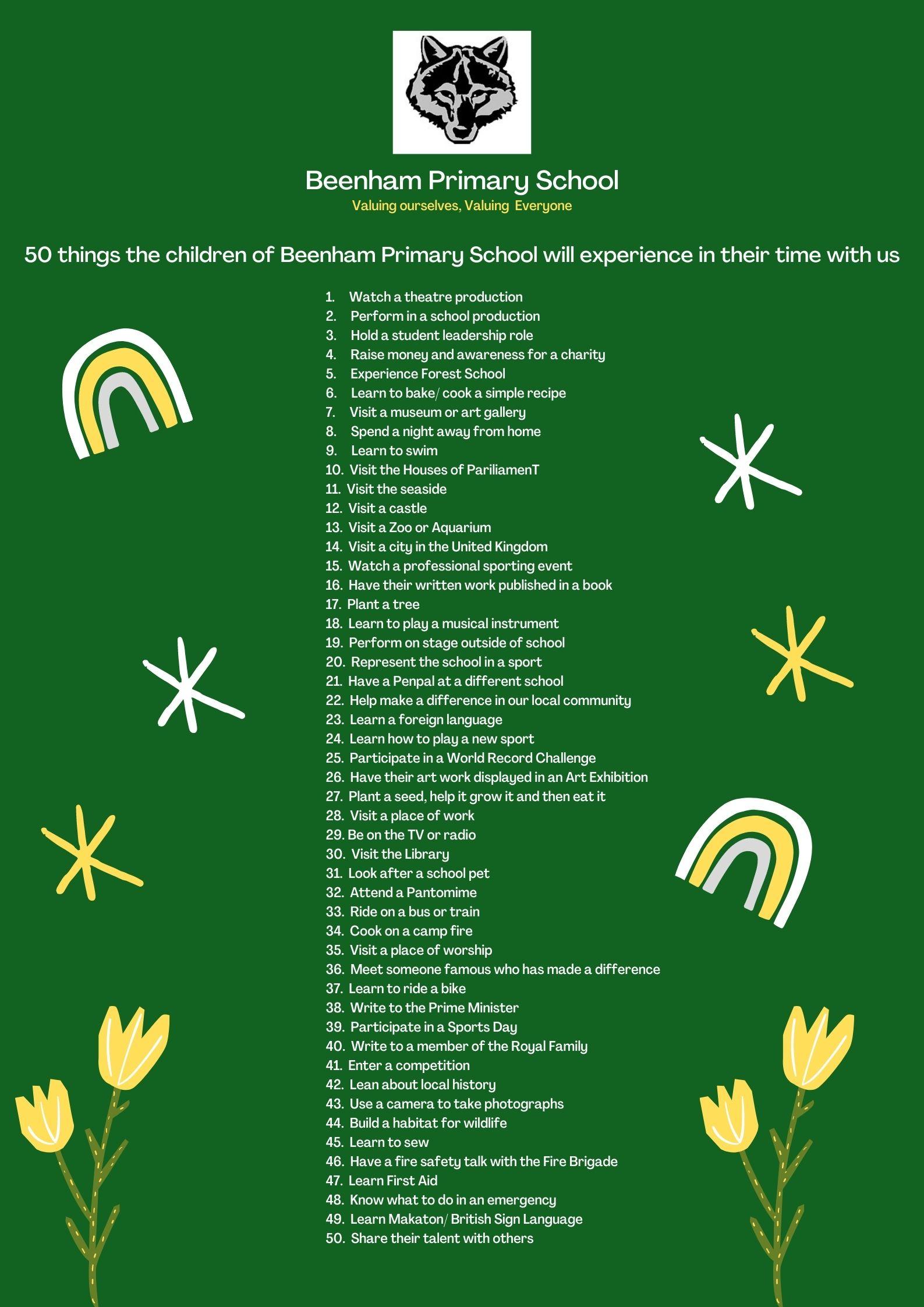
As a wider school community, we decided on 50 things we want our children to experience before they leave us for the next chapter in their education journey.
The curriculum at Beenham School is underpinned by our 6 school values and has been designed to meet the needs of the pupils who attend our school.
Here at Beenham Primary School, we provide a broad and balanced curriculum based around the Kapow Curricum.
What is Kapow?
We chose the Kapow schemes for most of our foundation subjects as it has a clear and sequential programme which enables children to develop deep knowledge and understanding. The programme is progressive and provides a structure for teachers, enabling them to plan high quality lessons with a consistent approach across the school.
On the Subject pages you will find Knowledge and Skills Progression Documents as well as National Curriculum Maps to show how each of the subjects links to the National Curriculum which is the basis, nationally, for all children's learning.
Please follow this link to see the National Curriculum for primary aged children in England
Fundamental British Values and Spiritual, Moral, Social and Cultural (SMSC) Curriculum
Our curriculum will give children the opportunity to understand:
- Tolerance and respect - To respect and tolerate the opinions or behaviour of others
- Individual liberty - Be free to express views or ideas
- Rule of law - Learn that all people and institutions are subject to and accountable for their actions and behaviour
- Democracy - Be part of a system where everyone plays an equal part
- Spiritual - Explore beliefs, experience and faiths, feelings and values; enjoy learning about oneself, others and the surrounding world; use imagination and creativity and reflect on experiences
- Moral - Recognise right and wrong and respect the law; understand consequences; investigate moral and ethical issues and offer reasoned views
- Social - Use a range of social skills to participate in the local community and beyond; appreciate diverse viewpoints; participate, volunteer and cooperate; resolve conflict
- Cultural - Appreciate cultural influences; appreciate the role of Britain’s parliamentary system; participate in culture opportunities; understand, accept, respect and celebrate diversity
Well-being
Our curriculum fully incorporates our 6 school values and will give children the opportunity to:
- build respectful and CARING friendships
- recognise that people are good at different things
- develop self-esteem, RESILIENCE and confidence in their abilities
- work INDEPENDENTLY and in COOPERATION with a range of groups
- reflect and take RESPONSIBILITY for their learning in the classroom and beyond
- follow their own interests and be CONFIDENT in who they are
- learn how to respect themselves and others.
Pupil voice
Our curriculum will give children the opportunity to:
- express their opinions on a range of different topics and issues
- contribute to planning their own learning
- explore ways of becoming an active citizen
- take part in democratic activities across the curriculum
- make choices about things that are important to them
- take part in age-appropriate discussions
- say what they like and dislike about their learning
- make a positive contribution to the school and local community.
Pedagogy
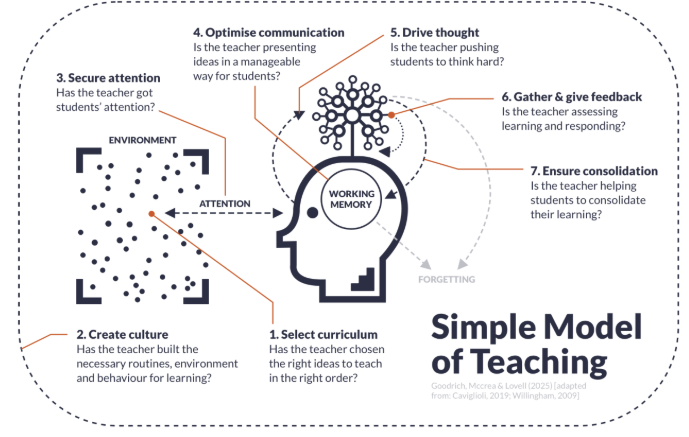
Our pedagogy is built on a clear, evidence‑informed model of teaching that helps children understand how to learn as well as what to learn. It is rooted in psychological principles and inclusive practice, ensuring every child can access learning, make progress and feel successful.
We focus on selecting and sequencing the right ideas, building a calm and purposeful learning culture, securing children’s attention, communicating new concepts clearly, and encouraging pupils to think deeply. Through ongoing feedback and opportunities to consolidate learning, children develop strong learning habits.
This approach supports all learners. By teaching the processes of learning explicitly, children become independent, resilient and consistently strengthen their skills as learners.
Our curriculum will be taught through a pedagogy that:
- enables children to reflect on and evaluate their learning
- enables and fosters children’s natural curiosity
- promotes innovation and entrepreneurialism
- offers all children a memorable experience at the start of every topic
- promotes problem-solving, creativity and communication
- excites, promotes and sustains children’s interest.
Should you wish any further information about the curriculum taught in school then contact Miss McBean the Headteacher.
Knowledge Organisers and Home Learning
We provide our children with knowledge organisers for each project and many other subjects, they add to these each year they are in the school and are encouraged to go back and use them to review prior learning and to make links in learning.